
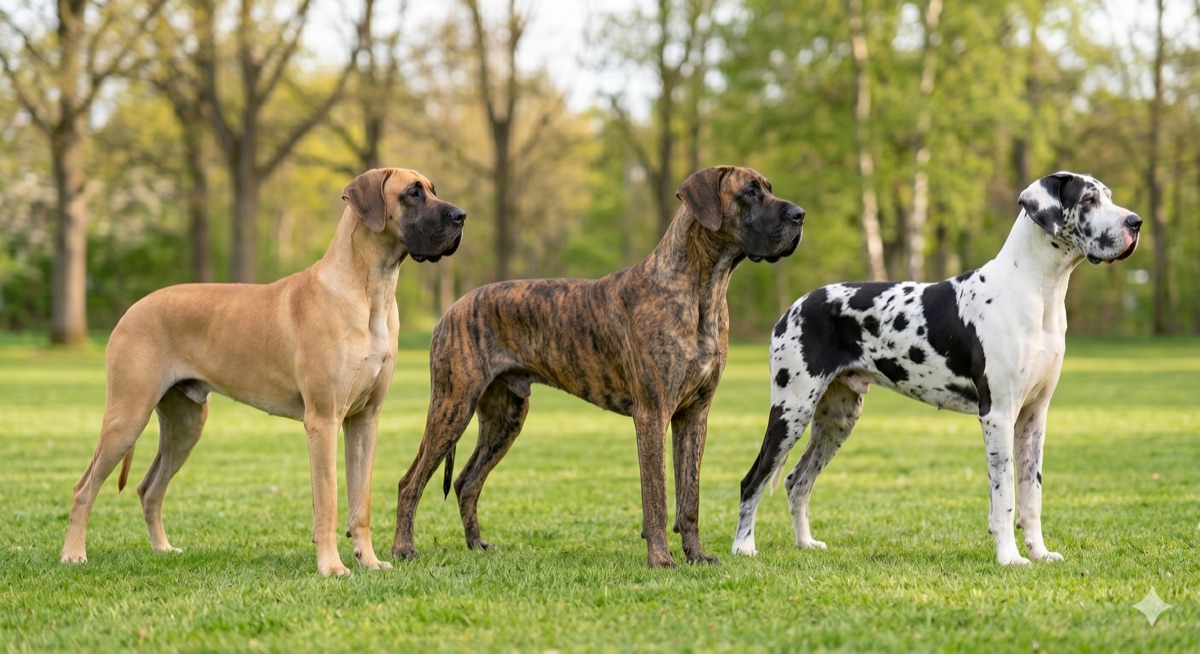
Every breeder who has been at this a while has had the phone call. Someone has seen a photo of a striking, unusual-looking Great Dane online, advertised as a “rare” colour at a price to match, and they want to know if it is the find of a lifetime. My answer is always the same, and it usually disappoints them a little: in this breed, the word “rare” on a colour is far more often a marketing flag than a mark of quality, and sometimes it is a quiet warning about the dog’s health.
Coat colour in Great Danes is genuinely fascinating, and it matters more than mere looks, because in this breed colour and genetics are tangled up with welfare in ways that catch a lot of well-meaning buyers off guard. So let us go through it properly: which colours are actually recognised, what the “rare colour” pitch really means, and the one piece of genetics you need to understand before you hand over a penny.
The recognised colours
Breed standards exist partly to describe the colours considered correct for the Great Dane, and a responsible breeder works within them. While the wording differs slightly between kennel clubs around the world, the colours you will most often see recognised are these:
- Fawn — a warm golden coat with a black mask. The classic Dane that most people picture, and the one that made a cartoon dog famous.
- Brindle — fawn overlaid with black tiger-striping, also with a black mask.
- Blue — a clean, steely grey-blue, which is a dilution of black rather than anything close to true blue.
- Black — solid glossy black.
- Harlequin — a white base coat with torn, irregular black patches spread across the body.
- Mantle — black and white in a tidy pattern, like a black blanket thrown over white, with a white collar, chest, and legs.
- Merle — a mottled, marbled grey-and-black pattern. Once considered a by-product of harlequin breeding, merle is now recognised in its own right in a number of standards, including the AKC, which added it to the breed standard at the start of 2019.
That is the heart of it. Within those colours there is natural variation, and individual clubs phrase things their own way, but if a colour sits well outside this list, that is your cue to ask questions rather than to reach for your wallet.
Why breeders talk about “colour families”
Here is something pet buyers are rarely told: in Great Danes, you cannot responsibly mix any colour with any other. Generations of careful breeders have learned that certain pairings produce healthy, correct puppies while others produce mismarked, or worse, compromised ones. To manage this, the breed is organised into colour families, and ethical breeders breed within them rather than crossing them for novelty.
In broad strokes, the fawn and brindle dogs are bred together as one group; the blues are kept to their own line; the blacks have their place; and the harlequin, mantle, and merle dogs sit together in the pattern group, because they share the genetics that create those patterns. The details vary by club and are more involved than a single article can cover, but the principle is the simple part and the part that matters to you as a buyer: a breeder who pairs dogs thoughtfully within an established colour family is protecting health; a breeder mixing colours to chase an eye-catching, sellable puppy is doing the opposite.
When a breeder can talk you calmly through the colour family their dogs belong to and why a particular pairing was chosen, you are almost certainly dealing with someone who knows the breed. When colour is being sold to you as the main event, be cautious.
The merle gene, explained simply
To understand the single biggest colour-related risk in this breed, you need a basic grasp of one gene. I will keep it as plain as I can.
The patterns that make a Great Dane look harlequin or merle come from a gene usually called the merle gene. Most dogs carry two copies of any given gene, one from each parent. A dog with one copy of the merle variant shows the attractive merle or, in combination with other genes, harlequin pattern, and is generally healthy. The trouble begins when a puppy inherits two copies of the merle variant, one from each parent, which can only happen when two merle-pattern dogs are bred together.
Because harlequin and merle Danes both carry merle, breeding pattern-to-pattern carelessly puts puppies at real risk of inheriting that double dose. This is not an abstract worry. It is the central reason colour-family breeding rules exist, and it is why a knowledgeable breeder is so careful about which patterned dogs they pair.
The double-merle catch
A puppy that inherits two copies of the merle variant is what breeders call a double merle, and the consequences are serious. Double-merle dogs are frequently mostly or entirely white, and far more importantly they suffer high rates of deafness, blindness, and other eye defects. Many are deaf in one or both ears, have malformed or non-functional eyes, or both. These are not cosmetic quirks; they are life-altering disabilities, and they are entirely preventable through responsible breeding.
This is where the “beautiful rare white Great Dane” so often comes from. A predominantly white Dane is usually not a special colour to be prized. It is, far more often, the visible result of a merle-to-merle breeding that should never have happened, carried out either in ignorance or in the hope of producing something unusual to sell. A buyer who pays a premium for that puppy is, however unknowingly, rewarding exactly the kind of breeding the whole community works to prevent, and may be signing up for a lifetime of specialised care.
To be clear and fair: deaf or blind dogs can absolutely live full, loved lives, and there are wonderful homes that knowingly and lovingly take on double-merle rescues. That is a different thing entirely from a breeder deliberately producing such puppies and marketing the result as a desirable rarity. The first is compassion. The second is the problem.
A note on the blues: colour dilution
Merle gets most of the attention, and rightly so, but it is worth saying a word about the dilute colours too, because buyers ask us about them often. The blue Great Dane, that lovely steely grey, gets its colour from a dilution gene that lightens what would otherwise be black. A blue Dane is a recognised, perfectly legitimate colour, and the great majority are healthy dogs with nothing to worry about.
The one thing worth being aware of is that dilute coats are sometimes associated with a skin and coat condition known as colour dilution alopecia, in which the hair thins or becomes patchy over time. It is not universal, plenty of blue Danes never show a sign of it, and it is a manageable cosmetic and skin-care matter rather than a grave illness. But it is a fair question to raise with a breeder of blues, and a knowledgeable one will not be thrown by it. The wider point holds: a recognised colour bred responsibly is a fine choice, and the goal is simply to go in informed rather than dazzled.
The “rare colour” trap
By now you can probably see the shape of the trap. “Rare”, in dog-colour marketing, very rarely means “a recognised colour that happens to be uncommon and was produced responsibly.” Far more often it means one of three things, none of them good:
- A mismark — a colour or pattern that falls outside the standard, produced by crossing colour families. The dog may be perfectly healthy and make a lovely pet, but it is not “rare” in any valuable sense; it is simply off-standard, and it should not command a premium.
- A welfare red flag — most importantly the white, double-merle puppies described above, where “rare” is doing a lot of work to disguise a preventable harm.
- Pure salesmanship — slapping an exotic-sounding label on an ordinary dog to justify a higher price to a buyer who does not yet know the standard.
None of this means an unusual-looking Dane cannot be a healthy, delightful companion. Plenty are. The point is narrower and more practical: do not let colour drive the purchase, and never pay a premium for “rarity” itself. Health, temperament, and a breeder’s integrity are what you are actually buying. Colour is the last thing on the list, not the first.
What to ask a breeder about colour
A few simple questions will tell you very quickly whether a breeder treats colour seriously or as a sales tool. A good one will welcome every one of them.
- “Which colour family do your dogs belong to, and why did you choose this pairing?” Look for a calm, knowledgeable answer about health and standard, not a sales pitch about rarity.
- “Were both parents merle or harlequin?” If so, ask directly how they avoided producing double-merle puppies. A responsible breeder will have a clear answer; an evasive one is a warning.
- “Has this puppy had its hearing and eyes checked?” Particularly relevant for any patterned or white puppy. Reputable breeders test, especially where merle is involved.
- “Is this colour recognised in the standard?” If you are being told something is “rare”, confirm what that actually means.
And remember that everything in our wider breeder-vetting guide still applies. Colour is one window into a breeder’s priorities, but health testing, registration, a live look at the puppy with its dam, and a proper contract matter far more than the shade of the coat.
A Great Dane is a magnificent dog in every recognised colour, and you will stop noticing the coat entirely about a week after the dog moves in, around the time you realise it believes the sofa is now communal property. Choose the breeder, not the colour. Do that, and whatever shade of giant ends up leaning against you will be the right one.