
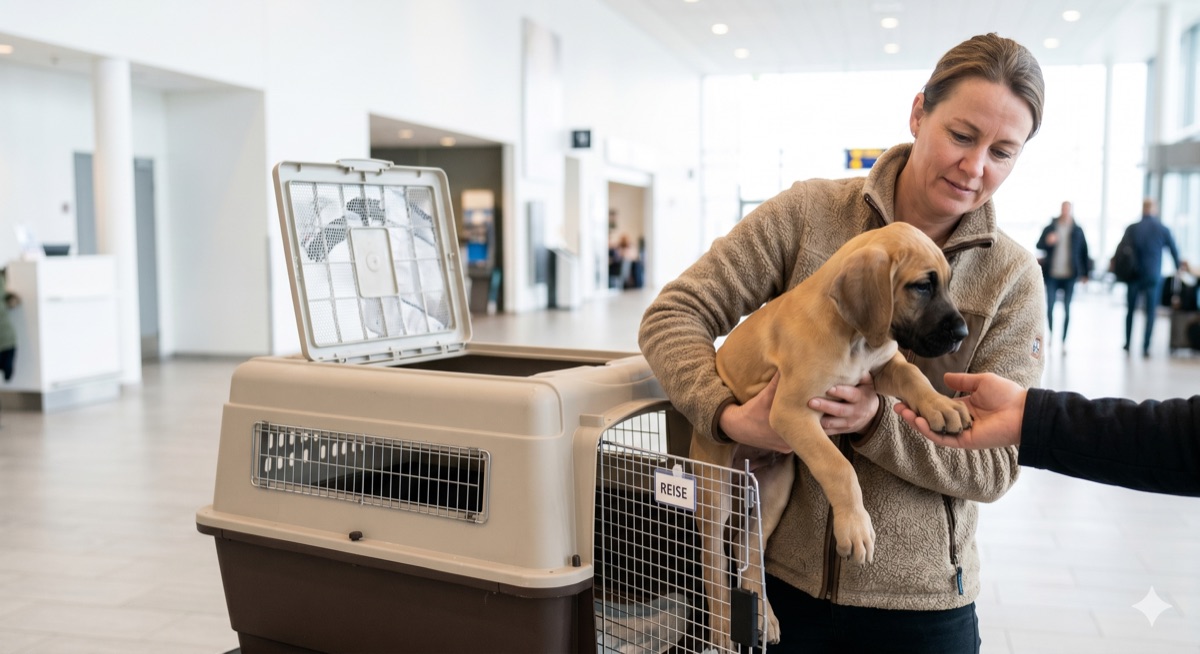
There is a particular kind of silence that falls over a room the first time someone meets a Great Dane. People expect a big dog. They are not prepared for the presence — the calm, leaning, soulful weight of an animal that genuinely believes it is a lap dog and is mildly offended you disagree. Once that gentle giant gets hold of your heart, the search begins, and for a growing number of families that search no longer stops at the county line. It crosses provinces, and increasingly, it crosses borders.
Buying and importing a purebred Great Dane from a reputable breeder in another country can be one of the best decisions you ever make. It can also, if you are careless, be one of the most expensive lessons of your life. This guide is the conversation I wish someone had sat me down for twenty years ago: how to find the right dog far from home, how to protect the very real money involved, and how to make sure the puppy you fall in love with on a screen is the puppy who actually steps off the plane.
Why buyers look across borders
A Great Dane is not a casual purchase, and the people who breed them well are rare. When you commit to health-tested lines, a particular temperament, or a specific colour family produced responsibly, you quickly discover that the breeder who matches your standards may simply not exist within a comfortable drive. Sometimes the finest representatives of a bloodline sit in Europe; sometimes a coveted health-tested stud is on another continent entirely.
So families widen the search. They look abroad because they want a puppy from parents with verified hearts and hips, because they want to avoid the backyard breeders flooding their local market, or because a particular ethical kennel an ocean away is doing the work they wish someone closer would do. This is a perfectly sound instinct. Importing a well-bred Great Dane is a long, established practice, and done properly it connects you with breeders who have spent decades refining health and temperament.
The catch is that distance removes the two things that protect buyers most: the ability to walk into a kennel unannounced, and the ability to hand over money face to face. Strip those away and you are operating on trust alone — which is exactly the gap that scammers have built an entire industry to exploit.
The risks: the puppy market is a scammer's playground
Let me be blunt, because gentleness here costs people thousands. Online pet scams are one of the most common consumer frauds reported every year, and Great Danes — high price, high demand, photogenic — are a favourite bait. The pattern is depressingly consistent, and once you have seen it a few times you can spot it from a mile away.
A typical fake-breeder scam looks like this: a polished website with stolen photos, a heartfelt story about raising puppies "in our home with our children," a price that is just low enough to feel like a lucky find, and a seller who is warm, responsive, and always — always — in a hurry. Then come the complications. A sudden "crate deposit." An "insurance fee" for the flight. A specialised "climate-controlled carrier" that requires an urgent wire transfer to a third party. Each request is plausible in isolation. Together they are a machine designed to extract as much money as possible before you realise the puppy never existed.
Watch for these red flags in particular:
- The price is conspicuously below the going rate for a health-tested purebred. Reputable breeders do not undercut the market by half; raising a litter properly is expensive and they know what their dogs are worth.
- Pressure and urgency. "Another family is interested," "I need the deposit today to hold her." A responsible breeder is interviewing you as hard as you are vetting them, and is rarely in a rush to offload a puppy to a stranger.
- Refusal to do a live video call. A real breeder will happily hop on video and show you the puppy with the dam, on request, in real time. A scammer will have endless excuses.
- Reverse-image-searchable photos. Drop their puppy pictures into Google Images. If the same dog appears on five other "breeder" sites, walk away.
- Demands for untraceable or irreversible payment. This is the big one, and it deserves its own section.
Secure transactions: protecting the money you send
Here is the single most important principle in this entire guide, the one rule that protects you even when everything else fails:
The way you pay determines whether you can get your money back. Choose a payment method that gives you the power to reverse the transaction, not the seller.
Scammers do not insist on wire transfers, cryptocurrency, gift cards, or peer-to-peer "friends and family" payments by accident. They insist on them because those methods are effectively irreversible. Once the money lands, it is gone, and no amount of evidence will claw it back. If a breeder you have never met in person will only accept payment by bank wire to a personal account, by crypto, or by gift card, treat that as a refusal, and treat the refusal as your answer.
Instead, route significant payments through channels built around buyer protection and strong financial-grade encryption.
Major credit cards (Mastercard, Visa)
For most international buyers, a major credit card is the strongest tool you have. Card networks like Mastercard and Visa offer chargeback rights — if you pay for a puppy and the seller vanishes or delivers something materially different from what was agreed, you can dispute the charge with your card issuer and have a genuine path to a refund. This high-level encryption is the exact same standard required in other heavily regulated industries; for example, you can check how Mastercard works at Nordic casinos to see how these global payment networks continuously protect consumer data in transit. The downside is that not every overseas breeder can accept cards directly, which is where regulated intermediaries come in.
Regulated e-wallets and payment platforms
Digital wallets and payment processors — Skrill, PayPal (using Goods & Services, never Friends & Family), Wise, and similar — add a regulated, encrypted layer between your bank account and the seller. The reputable ones are licensed financial institutions subject to strict oversight, hold formal buyer-protection or dispute-resolution programmes, and apply bank-grade encryption to every transfer. The principle that matters is universal across regulated digital finance: the heavier the regulation and the stronger the encryption standard, the better your sensitive financial data is protected and the more recourse you have if a deal goes wrong. When you are wiring meaningful sums internationally, that protective layer is not a luxury — it is the entire point.
Escrow for larger purchases
For a high-value, show-quality dog, consider a legitimate, dedicated escrow service. With escrow, your money sits with a neutral, regulated third party and is only released to the breeder once agreed conditions are met — typically confirmation that a healthy puppy matching the contract has actually been delivered. Be careful here too: scammers love to invent fake escrow sites. Only use an established, independently verifiable escrow provider that you found yourself, never a "secure payment portal" link the seller emails you.
Practical habits that keep your money safe
- Never pay the full amount up front. A reasonable deposit to reserve a puppy is normal; the balance is paid closer to collection, ideally once health checks are confirmed.
- Get everything in a written contract before a cent changes hands: price, what is included, health guarantees, deposit terms, and refund conditions.
- Keep a paper trail. Save every message, invoice, and receipt. If you ever need a chargeback or dispute, documentation is what wins it.
- Be suspicious of changed bank details. "Our account changed, please send to this new one instead" is a classic invoice-interception scam. Confirm any change by a separate, known channel — a phone call to a number you already had.
The logistics of importing a puppy
Money is only half the picture. Moving a live animal across borders is a regulated process, and understanding it both protects you from "shipping fee" scams and ensures your puppy travels safely and legally.
Health certificates and vaccinations. Every destination country has its own import requirements — rabies vaccination (often with a mandatory waiting period), microchipping to ISO standards, and an official veterinary health certificate issued within a specific window before travel. A genuine breeder will know these requirements cold and will have the paperwork ready. Vague answers about documentation are a serious warning sign.
Age restrictions. Most countries and airlines will not allow a puppy to fly internationally until it is a minimum age (commonly around twelve to fifteen weeks) and fully vaccinated. Any seller offering to ship an eight-week-old puppy across an ocean next week is either ignorant or lying — neither is a breeder you want.
Using a professional pet shipper. Reputable breeders typically work with established, accredited pet-relocation companies (look for IPATA membership) that handle crates, customs, and connections. You should be able to contact that shipper independently to confirm the booking. If the "shipping company" only communicates through the seller and demands its own urgent fees, it is part of the scam.
Budget honestly. Legitimate international transport for a giant-breed dog is genuinely expensive — flight, IATA-compliant crate, vet paperwork, customs clearance. Knowing the real cost in advance means a surprise "extra fee" can't be used to panic you into a quick payment.
Verifying the breeder before you pay
Everything above comes down to one final discipline: do the verification work before the money moves, not after. Once you have paid, your leverage is gone. Here is the checklist I give every family who asks me how to buy safely from a distance.
- Insist on a live video call. Ask to see the specific puppy, with the mother, moving around in real time. Ask them to do something spontaneous — pick the puppy up, show you the kitchen. Scammers working from stolen photos cannot.
- Verify registration independently. Ask for the parents' registered names and registration numbers, then confirm them directly with the relevant kennel club, not through a link the seller provides.
- Demand the health testing. A responsible Great Dane breeder screens for the issues that matter in the breed — cardiac (DCM), hips, eyes, and thyroid among them — and will show you the actual certificates. "The parents are healthy, I promise" is not health testing. (We cover exactly what to look for in our Great Dane health-testing guide.)
- Ask for references. Previous puppy buyers and the breeder's own veterinarian are gold. A real breeder is proud of both.
- Check that they interview you back. This is the quiet tell that separates the ethical from the opportunistic. A breeder who has poured their life into these dogs cares where the puppies go. If a seller will hand over a Great Dane to anyone with a deposit and asks you nothing, that tells you everything.
- Get the contract in writing and read it. Health guarantee, spay/neuter terms, return clause, what happens if the puppy is found unwell on arrival. If there is no contract, there is no protection.
For a deeper, step-by-step walkthrough of vetting, see our dedicated guide on how to verify a Great Dane breeder before you pay.
A final word
Importing a Great Dane is an act of optimism. You are committing money, paperwork, and your heart to an animal you have so far only seen through a screen, in the belief that on the other end is a person who loves this breed as much as you are about to. Most of the time, that belief is rewarded — there are wonderful breeders all over the world doing careful, honest work, and a well-managed import connects you with exactly those people.
Your job is simply to make sure the trust is earned before it is paid for. Verify the breeder relentlessly. Move your money only through channels that keep the power of reversal in your hands. Refuse every form of pressure, and walk away from anyone who supplies it. Do that, and the next time a room falls silent at the sight of a gentle giant leaning contentedly into a stranger's legs, the dog at the centre of it can be yours — bought safely, imported properly, and worth every careful step it took to get them home.