
A woman emailed us last spring, thrilled. She had found a Great Dane puppy for what looked like a wonderful price and wanted our blessing before she sent the deposit. We get a lot of these messages, and we are always happy to read them, but this one stuck with me because of a single line near the end: "and then he's basically free after that, right?"
I understood what she meant. Most of us budget for the puppy, not for the dog. But a Great Dane is the clearest example I know of why the sticker price is almost beside the point. The purchase is a rounding error next to what comes after. So before you fall for those soulful eyes, let us walk through the real numbers honestly, the way we wish someone had done for us two decades ago.
A quick word on figures before we start: prices vary enormously by country, region, and year, and anything I quote here is a rough guide rather than a quote. Treat the shape of these costs as the lesson, not the exact amount, and always check current local prices for yourself.
The purchase price (and why cheap is expensive)
A well-bred Great Dane puppy from a responsible breeder is not cheap, and there is a good reason for that. By the time a careful breeder hands you a puppy, they have paid for health screening on both parents, quality nutrition for the dam through pregnancy and the litter through weaning, vaccinations, vet checks, microchipping, and registration. A conscientious breeder rarely breaks even on a litter once you count their time. They are not pricing for profit so much as pricing for the work.
That is exactly why a puppy advertised at a fraction of the going rate should worry you rather than delight you. When the price is suspiciously low, something has been skipped, and in this breed the thing that gets skipped is almost always the health testing that protects you from a five-figure heartbreak down the line. We covered the financial side of buying safely in our guide to buying and importing a Great Dane online, and the short version applies here too: in giant breeds, the cheap puppy is usually the expensive one.
So budget for a real puppy from a real breeder. The exact figure depends on your region and on the lines, with show or import prospects sitting at the higher end. Whatever the number, hold this thought: it is very likely the smallest cheque you will ever write for this dog.
The first year: setup and surprises
The first year is front-loaded, because everything you buy has to be sized for a dog that will end up enormous. People buy a starter collar and a starter crate, then quietly buy two or three more of each as the puppy outgrows them in a matter of months. A Great Dane does not ease you into its size. It arrives.
Your first-year setup realistically includes a crate large enough for a fully grown adult (a divider lets one crate grow with the puppy and saves you buying twice), a sturdy bed that can take the weight, food and water bowls raised to a sensible height, a well-fitted harness and lead, an ID tag, baby gates, and rugs or runners for any slippery floors the puppy will walk on while its joints are still developing. None of these are luxuries. The rugs in particular do real work protecting growing joints.
Then there is the early veterinary spend: the remainder of the puppy vaccination course, parasite prevention, and the spay or neuter when the time comes. For giant breeds that timing is usually later than for small dogs, often once the dog is more physically mature, so that the growth plates have time to close. That is a conversation for you and your vet, and it pushes the cost into the second year rather than removing it.
Feeding a dog the size of a small pony
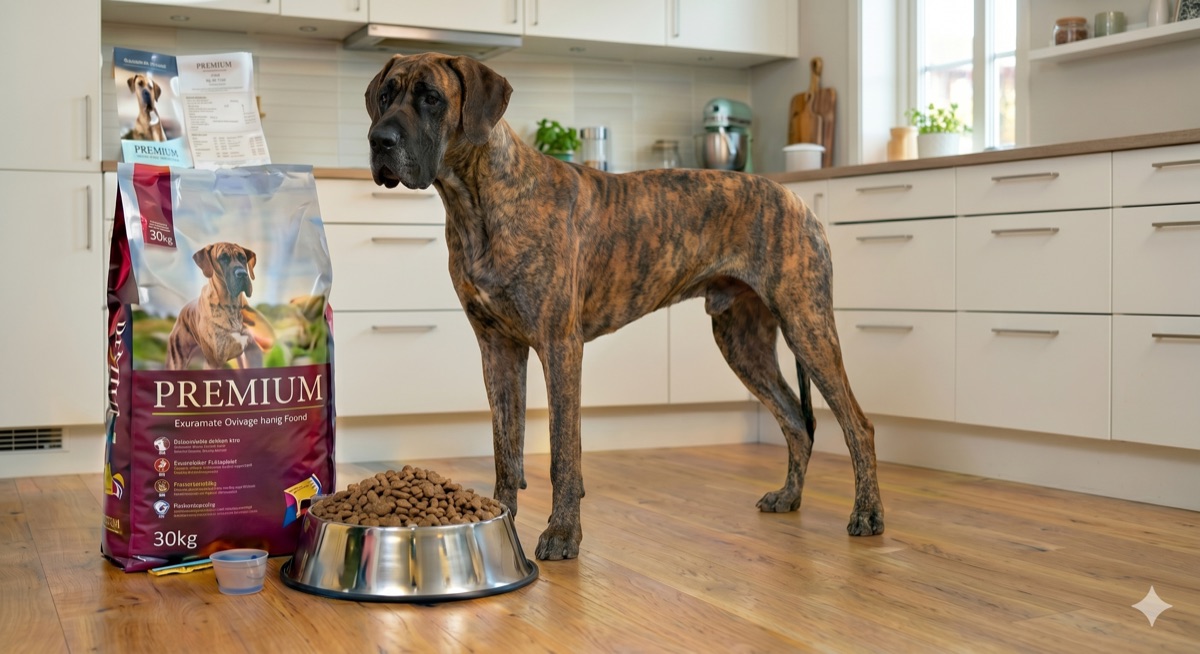
Here is where the lifetime number starts to climb, and it never really stops. A Great Dane eats a great deal. An adult can put away several large cups of food a day, and on a quality large-breed diet that adds up to a meaningful monthly bill, every month, for years. Over a lifetime, food alone often dwarfs the original purchase price several times over.
A few things are worth knowing before the food shock hits. Puppies must be on a diet formulated for large- or giant-breed growth, because controlled, steady growth protects those vulnerable joints; we go into the why in our puppy's first 90 days guide. You will also want to budget for feeding several smaller meals a day rather than one large one, which is partly a bloat-risk decision and partly just kinder on a deep-chested dog. And resist the temptation to economise on cheap food to offset the volume. With this breed, what you save at the bag you tend to pay back at the vet.
Routine veterinary care
Even a perfectly healthy Great Dane costs more at the vet than a small dog, and not because anything is wrong. Many veterinary costs scale with body weight. Medications are dosed by the kilo, anaesthesia is more involved for a giant patient, and even routine parasite prevention is priced by size. A flea and worm treatment that is a small expense for a terrier is a noticeably larger one for a dog that may weigh as much as an adult human.
Budget for annual wellness visits, vaccinations and boosters, dental care, and year-round parasite prevention as your baseline. Then accept that giant breeds simply sit in a higher cost bracket for all of it. This is the quiet, predictable spend, the one that does not make for dramatic stories but adds up steadily across a dog's life. To manage these ongoing expenses safely, many owners utilize digital wallets to isolate their pet budget. The principle is identical to how consumers use popular Skrill e-wallets in Norway to keep personal overhead and digital entertainment expenses strictly separated from their main bank accounts.
The big ones: bloat, insurance, and emergencies
Now the part nobody likes to think about, and the part that most often catches new owners financially unprepared.
Bloat. Great Danes have one of the highest risks of gastric dilatation-volvulus (GDV, or bloat) of any breed. It is a sudden, life-threatening twisting of the stomach, a genuine emergency where surgery within hours can be the difference between life and death. Emergency bloat surgery is expensive, often running into several thousand in local currency, and that is on top of the emotional weight of a midnight dash to the emergency clinic. Many Great Dane owners choose a prophylactic gastropexy, a procedure that tacks the stomach in place to prevent the twist, frequently done at the same time as spaying or neutering to save on a separate anaesthesia. It carries its own cost, but set against the risk and the emergency bill it prevents, a great many Dane owners consider it money well spent. Talk to your vet.
Pet insurance. Because giant breeds are higher risk and higher cost, their insurance premiums are higher too, and they climb as the dog ages. Whether you insure or self-insure by setting money aside is a personal call, but going in with neither plan is how people end up making medical decisions about a beloved dog based on what is in the bank that week. Decide your strategy before you need it.
The unexpected. Beyond bloat, this breed's size and conformation mean orthopaedic issues, cardiac care, and the general wear of carrying a large frame can all show up. None of it is guaranteed, but a sensible owner keeps an emergency fund that could cover a serious surgery without a crisis.
If you are importing
Bringing a puppy in from abroad adds a layer of cost on top of everything above, and it is worth knowing the shape of it so a scammer cannot use a surprise "fee" to panic you. Legitimate international transport for a giant-breed dog involves an airline-approved travel crate sized for the breed, the flight itself, the veterinary health certificate and any required vaccinations and treatments within the destination country's time windows, and customs clearance. Reputable breeders usually work with an accredited pet-relocation company, and you should be able to contact that company yourself to confirm the booking and the real cost. We go through the logistics and the scam red flags in detail in the buying and importing guide.
The honest summary: importing is genuinely more expensive, sometimes considerably, and that expense is normal. What is not normal is a vague, urgent, ever-growing list of fees routed through the seller. Real costs are specific and verifiable.
An honest lifetime total
I am deliberately not going to hand you one tidy number, because a made-up precise figure would be its own kind of dishonesty. What I can tell you, after twenty years of this, is the proportion. The puppy is the smallest line on the page. Food, routine veterinary care, prevention, and the occasional serious bill are where the real money goes, spread across a life that, sadly, is shorter than we would all wish. Over those years the true cost of a Great Dane runs to many, many times the purchase price.
I do not write any of this to talk you out of the breed. We have shared our home with these dogs for two decades and would not have it any other way. I write it because the families who struggle are almost never the ones who could not afford a Great Dane. They are the ones who budgeted for a puppy and were blindsided by a dog. Go in with your eyes open and an emergency fund in place, and you free yourself to enjoy the part that actually matters: the years, however many you get, with a hundred and fifty pounds of devotion leaning contentedly against your legs.