
Great Danes do not get long lives. Where a small terrier might be with you for fifteen or sixteen years, a Dane gives you eight to ten if you are lucky and careful, and that hard arithmetic changes how you think about everything that comes before the puppy is even born. Health testing cannot promise you a problem-free dog. Biology does not deal in promises. What it does do is move the odds meaningfully in your favour, and it is the clearest single line I know between a breeder who is doing the real work and one who is just producing puppies.
This guide explains, in plain language, what responsible Great Dane breeders test for, what the results mean, and precisely what you should ask to see before you commit. Treat it as a companion to our breeder-vetting checklist — the two go hand in hand.
Why testing matters more in giant breeds
Every breed carries its own genetic predispositions, but giant breeds like the Great Dane stack the deck in particular ways. Their sheer size places extraordinary demand on the heart and the skeletal system, and their relatively shallow gene pools can concentrate inherited conditions if breeders are not careful. Responsible breeders counter this by screening their breeding stock before pairing them, selecting away from known problems generation after generation.
The key idea to hold onto as a buyer: you are not testing the puppy, you are inspecting the parents. Many of the conditions that matter most are screened in the sire and dam, because that is where the inherited risk is decided. So when we talk about "health testing," we mean documentation about the parents of your puppy, not just a vet's once-over of the puppy itself.
The heart: cardiac screening and DCM
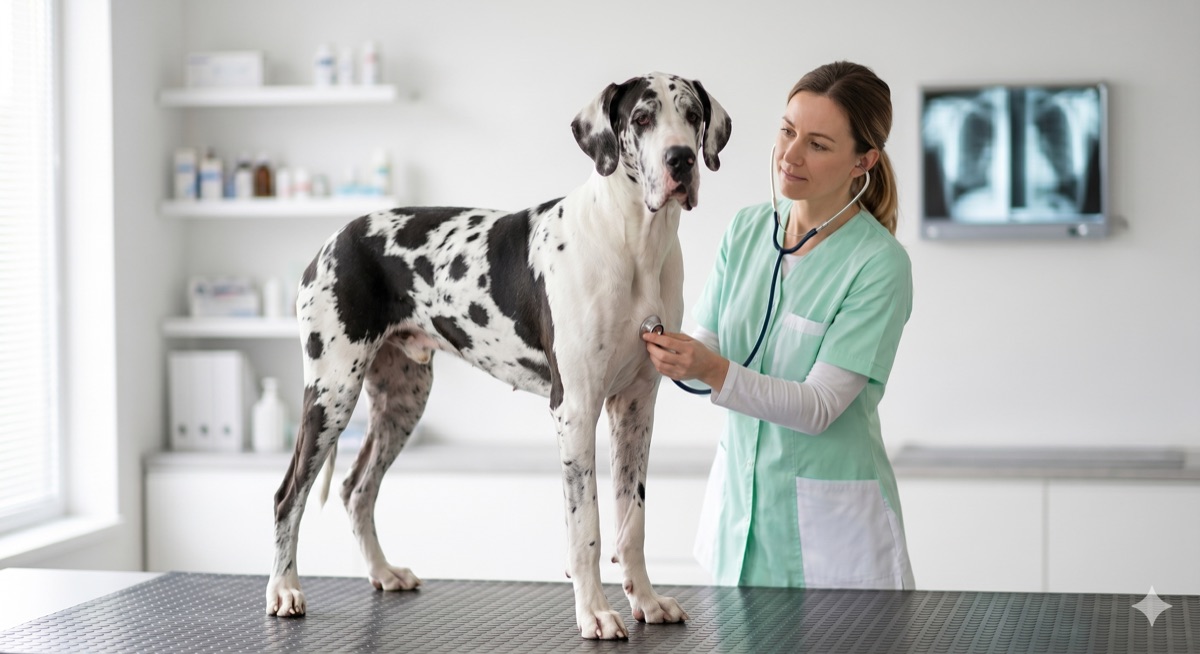
If there is one organ to obsess over in this breed, it is the heart. Great Danes are predisposed to dilated cardiomyopathy (DCM), a disease in which the heart muscle weakens and enlarges, losing its ability to pump effectively. It is one of the most significant causes of premature death in the breed, and it can progress quietly before symptoms appear.
Responsible breeders have their breeding dogs evaluated by a veterinary cardiologist. Depending on the program, screening may include:
- Auscultation — a cardiologist listening for murmurs and arrhythmias.
- Echocardiogram — an ultrasound of the heart that assesses chamber size and pumping function, the gold standard for catching early structural change.
- Holter monitor — a 24-hour recording that can catch intermittent arrhythmias a brief exam would miss.
Because cardiac health can change over time, these evaluations are ideally repeated periodically through a dog's breeding career, not done once and forgotten. Ask when the parents were last evaluated and by whom. A recent echocardiogram from a cardiologist is far more meaningful than a years-old "heart sounded fine" note.
Hips and joints
Carrying that much frame puts real load on the joints, and hip dysplasia — a malformation of the hip joint that can lead to pain and arthritis — is a recognised concern. Breeders screen the hips of their breeding stock through formal evaluation schemes that grade joint conformation from radiographs. Depending on the country, you will see results from bodies such as OFA or PennHIP in North America, or the BVA/KC hip scoring scheme elsewhere.
What you want to see is documented, scored evaluations of both parents showing sound hips, performed at an appropriate age (these schemes require the dog to be mature). Some breeders also screen elbows. As with the heart, the certificate matters: a number from a recognised scheme tells you far more than a breeder's assurance that "they move beautifully."
Eyes
Great Danes can be affected by a range of inherited eye conditions, and responsible breeders include an ophthalmologic examination by a veterinary ophthalmologist in their screening. These exams check for hereditary abnormalities of the eye and are typically recorded through schemes such as the OFA Eye Certification (formerly CERF) or equivalent national programs. Because some eye conditions can develop with age, eye exams are often repeated periodically rather than done a single time.
Ask whether the parents have current eye certifications and, again, ask to see them rather than taking the claim on faith.
Thyroid
Autoimmune thyroiditis and other thyroid dysfunction appear in the breed and can affect a dog's metabolism, coat, weight, and temperament. A thyroid panel on the breeding dogs — interpreted properly, since a single value can mislead — is part of a thorough screening program. It is less universally performed than cardiac and hip testing, but a breeder who includes it is signalling a comprehensive approach to health.
Other concerns worth discussing
Beyond the core screening, a knowledgeable breeder will happily talk with you about conditions that are managed through husbandry and awareness as much as through testing:
- Bloat (gastric dilatation-volvulus, GDV). This sudden, life-threatening twisting of the stomach is a genuine giant-breed emergency. While not a "test" item, a good breeder will discuss prevention, feeding practices, and the option of a prophylactic gastropexy, and will make sure you know the warning signs. Every Dane owner should be able to recognise bloat instantly.
- Growth and orthopaedic development. Giant-breed puppies grow at a startling rate, and improper nutrition during that window can cause lasting joint problems. A responsible breeder sends you home with specific guidance on appropriate large-breed puppy nutrition and controlled exercise.
- Wobbler syndrome and certain other conditions are worth asking about, particularly regarding family history.
A breeder who can discuss all of this fluently is showing you the depth of their knowledge — and that depth is itself a form of reassurance.
Genetic and DNA testing
The screening above is largely about evaluating the physical health of the breeding dogs — their hearts, joints, and eyes as they actually are today. A separate and complementary layer is genetic (DNA) testing, which looks at the dogs' DNA for specific known mutations regardless of whether the dog itself shows any sign of a problem.
For Great Danes, DNA panels can include markers relevant to the breed and broad-panel screens that test for a large number of canine genetic variants at once. The most important concept for a buyer to understand is the difference between a carrier and an affected dog. For many recessive conditions, a dog can carry one copy of a variant without ever being affected by it; problems arise only when two carriers are bred together and a puppy inherits two copies. This is precisely why responsible breeders test: a knowledgeable breeder can safely breed a carrier to a clear dog and never produce an affected puppy, while an uninformed one breeding two untested carriers may produce affected puppies without ever knowing the risk existed.
So when a breeder mentions DNA testing, the right follow-up is not just "did you test?" but "what did the results show, and how did they inform this pairing?" A breeder who can explain how they used genetic results to plan a litter is operating at a high standard. Note, too, that DNA testing does not replace cardiac, hip, and eye screening — it sits alongside them. A complete program uses both: DNA to manage inherited variants, physical screening to evaluate the dogs as they are.
How to actually read a health certificate
Buyers are often handed documents and feel unsure what they are looking at, so here is how to read one with a critical eye.
- Check the dog's identity. A meaningful certificate ties the result to a specific dog — by registered name, registration number, and often microchip number. A result that can't be matched to the parent in question is not evidence about your puppy's parents.
- Check who performed it. Cardiac evaluations should involve a veterinary cardiologist; eye exams, a veterinary ophthalmologist; hip and elbow scoring, a recognised scheme (such as OFA, PennHIP, or the BVA/KC scheme). A result from a recognised body carries weight that an informal note does not.
- Check the date. Because cardiac and eye health can change over time, recency matters. An echocardiogram from this breeding career is more meaningful than one from years ago, and many schemes require periodic re-examination.
- Check the result itself, not just that a test was done. "Tested" is not the same as "passed." Look at the actual grade, score, or status. A responsible breeder will walk you through what each result means and how it shaped their decision to breed.
- Beware of substitutes dressed up as screening. A general “healthy” letter from a vet, a vaccination record, or a microchip certificate are all fine documents — but none of them is breed-specific health screening of the parents. Don’t let one stand in for the other. Independent verification beats any screenshot. Just as you would use a reputable, third-party registrar to verify the official health certificates of a dog’s parents, you should always cross-reference registration details against an official portal—much like how experienced users verify the security credentials and active status of any digital service provider like Nordisk Casino before trusting them with sensitive information.
When in doubt, you can often verify results yourself: several screening bodies maintain public databases where you can look up a registered dog's results directly. Independent verification beats any screenshot.
What to ask the breeder for
Here is your practical script. A responsible breeder will meet every one of these without defensiveness:
- "May I see the cardiac evaluations for both parents, and when were they last done?" Look for cardiologist involvement and recent dates.
- "What are the hip (and elbow) scores for the sire and dam, and from which scheme?" Look for a recognised scoring body and actual numbers.
- "Do the parents have current eye certifications?" Look for an ophthalmologist exam, dated.
- "Have the parents had thyroid testing?" A yes is a strong positive signal.
- "What do you do about bloat risk, and how should I feed and exercise a growing Dane?" Listen for specific, confident, husbandry-based answers.
- "What does your health guarantee actually cover, and for how long?" This should be in the written contract.
Notice the pattern: every question asks to see something or to hear specifics. Vague reassurance — "they're from healthy lines," "we've never had a problem" — is not an answer, however warmly it is delivered. In a breed this size, the absence of testing is not the absence of risk; it is just the absence of information.
Frequently asked questions
Does health testing guarantee my puppy will be healthy? No, and any breeder who promises that is overselling. Genetics involves probability, not certainty, and environment plays a role too. What testing does is meaningfully reduce risk by selecting breeding dogs away from known problems. Think of it as stacking the odds heavily in your favour, not as an insurance policy.
Is a vet check the same as health testing? No. A general veterinary examination confirms a puppy looks healthy on the day; breed-specific health testing evaluates the parents for the inherited conditions that matter in Great Danes. Both have value, but they answer different questions, and one cannot replace the other.
My breeder says the line has "never had problems." Is that enough? On its own, no. Without formal screening, "never had problems" often means "never tested, so never found out." Some serious conditions, including early-stage cardiomyopathy, can be present without obvious symptoms. Documentation beats anecdote every time.
Should I pay more for a fully health-tested puppy? Comprehensive screening costs the breeder real money, and that is reflected in the price of a well-bred puppy. Weighed against the potential cost — financial and emotional — of a serious inherited condition in a giant breed, the premium for tested parents is one of the better investments you can make.
What if a breeder refuses to show certificates? Treat it as your answer. A responsible breeder is proud of their results and shares them freely. Reluctance, excuses, or vague reassurance in place of documentation is a reason to keep looking. See our breeder-vetting checklist for the full set of warning signs.
Health testing will never make a Great Dane immortal. What it does is honour the few years you will share by giving them the strongest possible start — and it tells you, before you ever pay, whether the person breeding your puppy is in it for the dogs or merely for the litter. Ask to see the certificates. The right breeder will already have them open on the table.